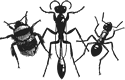


This is the most common of our Oxybelus species.
Most recently added content
Submitted by Anonymous on
,
The 'median wasp' is a very large social species, most individuals being second only to the hornet, Vespa crabro, in size. Queens of D. media also resemble V. crabro in their mainly yellowish-orange coloration. The gasters of many workers are very dark, with narrow yellow bands. Most colonies are rather docile; others seem to be very aggressive, attacking with little provocation (Welch & Irwin, 1995).
Submitted by Anonymous on
,
Specimens of the 'Saxon wasp', the second species of social wasp to have recently colonised England, are more difficult to identify in the field than its congener D. media. It is a very close relative of D. norwegica but lacks the pair of red spots on the second gastral tergum (but beware, these markings are also absent in some D. norwegica).
Submitted by Anonymous on
,
The genus Ectemnius contains some of our larger and more colourful aculeates. All ten British species in this genus have black gasters which are boldly marked with yellow transverse bands or paired lateral spots. Most are locally distributed throughout much of southern England, the number of species and their degree of abundance decreasing northwards. Only three species are known from Ireland (Stelfox, 1927) and a similar number from Scotland.
Submitted by Anonymous on
,
Ectemnius cavifrons is one of the largest and most common species of its genus in Britain.
Submitted by Anonymous on
,
This is a very close relative of Ammophila sabulosa; in many of its sites it flies with its congener, and may be locally abundant.
Submitted by Anonymous on
,
This is a conspicuous and relatively large solitary species.