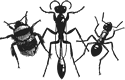


Exiting news from the ant world. Andrew Jarman has just discovered Leptothorax muscorum in a remote spot in Scotland. This ant is new to the list for the British Isles but may well have been overlooked up until now as it is quite similar to L. acervorum. Andrew suggests that those of us with voucher specimens of L. acervorum should check then carefully. There is a profile page here with pictures and description that should help you differentiate between these two species.… Read more
Most recently added content
Submitted by Mike Fox on
,
A small myrmicine ant, forming small, unobtrusive colonies with less than 100 workers and one or occasionally two queens. Leptothorax muscorum closely resembles the widespread L. acervorum (q.v.) in having 11 antennal segments, but is slightly smaller, slenderer, and paler with yellowish-brown midbody contrasting with darker gaster and head. The colour differences are variable, but with a lens L. muscorum and L. acervorum are readily distinguishable by the absence or presence respectively of stiff erect hairs on their tibiae. It could be… Read more
Submitted by Mike Fox on
,
ANTS (SECOND EDITION) by Gary J Skinner & Andrew P Jarman 25% discount. Use code BRC25 at the checkout to save 25%. Only from www.pelagicpublishing.com
Submitted by Mike Fox on
,
Learn about ants of the genus Myrmica, a group of ants that can be tricky to identify and includes the Common Red Ant.
For details and tickets click here
Submitted by Mike Fox on
,
Learn how how the complex lifestyle of social insects leads to complex reproductive models in the Brad Ashby Memorial Lecture.
Submitted by Mike Fox on
,
Learn about ants of the genus Lasius, including familiar species such as the Yellow Meadow Ant and the Black Garden Ant.
Submitted by Mike Fox on
,
Sofia Dartnell (University of Cambridge) shares her research looking at the lifecycles and impacts of cuckoo bumblebees.
Submitted by Mike Fox on
,
Emma Plant (University of Glasgow) shares her research investigating how private green spaces support pollinator diversity in cities.
Submitted by Mike Fox on
,
Learn about ants of the genus Formica, including the wood ants and the slave-maker ant.
Formica ants are a genus of medium to large ants found across the Northern Hemisphere that includes the wood ants. They are highly social insects that live in large colonies, often building mound-shaped nests from soil and plant material, and are known for their aggressive defence using formic acid, a chemical named after them. Formica ants play an important ecological role by controlling other insect populations, aerating soil, and sometimes farming aphids for honeydew, with… Read more
Submitted by Mike Fox on
,
Tetramorium alpestre Steiner et al., 2010, a newly recognised ant species, has been added to the website. A map will follow.