

See Oxybelus uniglumis for general notes on this species.
Most recently added content
Submitted by Anonymous on
,
This species is a very close relative of C. ruficornis and care is necessary to distinguish between them, particularly when identifying males.
Submitted by Anonymous on
,
Ecological studies in the Norfolk Brecklands (Field & Foster, 1995; Willmer, 1985a,b) and Europe (Hamm & Richards, 1930) make this one of the best-known British aculeates.
Submitted by Anonymous on
,
See Symmorphus crassicornis for literature on this species.
Submitted by Anonymous on
,
Identification keys, distribution and general biology are given in Spradbery (1973), Richards (1980), Yeo and Corbet (1995), and Falk (1991).
Submitted by Anonymous on
,
See Symmorphus crassicornis for literature on this species.
Submitted by Anonymous on
,
The Embolemidae is a small family with 10-15 species worldwide. E. ruddii is the only species in Britain. Notes on identification may be found in Perkins (1976).
Submitted by Anonymous on
,
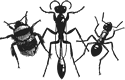
This is the larger of the two species of British mutillids (the other being Smicromyrme rufipes). Unlike many aculeate wasps, the female is apterous, a feature which gives it an ant-like appearance, and leads to its being called a 'velvet ant'. The male, however, is fully winged and capable of sustained flight.
Submitted by Anonymous on
,
One of our largest pompilids, and until recently, regarded as one of our rarest.