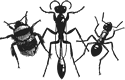


Until recently this species was known as gracilis Haupt, 1927 (Wahis, 2006; Collins, 2010). The male is relatively distinctive on the subgenital plate, but the female belongs to the difficult group of Priocnemis.
Most recently added content
Submitted by Anonymous on
,
A medium-sized species with red and black gaster; the female with bifasciate wings. Males are easy to identify by the characteristic genital plate. However, females can be very difficult to identify and the advice of Day (1988), that some individuals cannot be placed to species, should be heeded.
Submitted by Anonymous on
,
Priocnemis exaltata belongs to Priocnemis sens. str. Males can be identified by examination of the genitalia, and females recognised by the long metapostnotum. It is one of the largest species in its subgenus.
Submitted by Anonymous on
,
Priocnemis fennica belongs in Priocnemis sens. str., where, along with hyalinata (Fabricius), it exhibits the character of a greatly enlarged inner tooth on the tarsal claw. Males exhibit distinct differences in their genitalia in comparison to hyalinata; females of both species are more similar and the characters to separate them more subtle (Day, 1988).
It has only relatively recently been recognised as British (Day, 1979) and older records of ‘hyalinata’, or its synonym femoralis, might refer to either species; fennica… Read more
Submitted by Anonymous on
,
There have been two names applied to this species which is possibly an intermittent resident in Britain: Polistes dominula and P. gallicus. Confusingly, the true P. gallicus (Linnaeus) has also been found in Britain, but only as a vagrant. The best characterised instance of a reproductive and long-term colony was one found by the author in the roof of the Orangery at Ham House, Petersham, Surrey. Here there were many nests under the tiles and this situation persisted at least between 2003 and 2010; they may still be there. A number of other records may well… Read more
Submitted by admin on
,
If you want to add a new top level menu item, e.g. a section called “About” under which we can put pages “About this site” and “Contact Us”:
- Select *Site building > Menus > List menus* from the menu then choose the *Primary Links* menu, as this menu is normally the site’s main menu.
- You should now see the edit page for a new menu item. Set the Path to nolink because we want this menu item to be a parent item which does not have a page associated with it. Set the Menu Link Title to the title of your menu parent item.… Read more