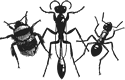


A large, mainly dark mining bee, though the gasters of some females are occasionally extensively marked with red. In general, males are more commonly encountered than females, especially in the spring.
Most recently added content
Submitted by Anonymous on
,
Although usually referred to as scotica in Britain, Schwarz et al. (1996) and Gusenleitner & Schwarz (2002) have treated scotica as a synonym of carantonica Peréz. However, Else & Edwards (in press), following P. Westrich’s (in litt.) interpretation of the type of carantonica, regard this is a separate species, with carantonica a junior synonym of trimmerana. It is one of the larger Andrena species, with a generally dark brown abdomen and a contrasting pattern of dark upper and pale lower hairs on the scopa of the hind leg. This… Read more
Submitted by Anonymous on
,
The females of this medium-sized Andrena can be found very commonly in late spring, often visiting the flowers of early umbellifers. Typical specimens are fairly easily recognised in the field: the male has a yellow clypeus with two small black dots at the sides, the female has a shining black abdomen with thin white hair lines at the apices of the segments and a tuft of brown-gold hairs at the tip. The scopa on the hind leg is a bright golden colour. Unfortunately, this happy state of affairs is often upset by the high frequency of stylopised specimens, where all manner of… Read more
Submitted by Anonymous on
,
A very smart-looking bee when freshly emerged, with bright foxy hairs on the thorax and a shining black abdomen with thin lines of white hairs on the apices of the segments. The males rapidly become very faded. A good character to separate the females is the form of the hind tibia which is widest at the apex, unlike the rest of the bees with this general appearance. When I first became interested in the aculeates in the 1970s this was a fairly scarce bee, but since then it has become one of the commonest andrenid bees, at least in the southern half of England.
Submitted by Anonymous on
,
The females of this medium-sized Andrena are very like those of Andrena bicolor Fabricius, but can be found in May, between the main flight periods of that species. Careful examination of the clypeus of female Andrean angustior will show a faintly impressed vertical line, not present in bicolor. Males of Andrena angustior seem to be generally scarce, the reason is not known.
Submitted by Anonymous on
,
This bee is one of eleven British species in the subgenus Micrandrena. These are very small species (body length 5–7 mm) that have an entirely black body integument relieved only by feeble transverse lateral bands of silvery hairs on tergites 2–4. Several species present difficult challenges to identification, as this often requires an appreciation of very subtle differences in surface microsculpture on the metasomal tergites and puncture density on the mesonotum. More pictures and notes … Read more
Submitted by admin on
,
If you need to add a newsletter file, or other file to the Downloads page, then select Content management > Create content > Download from the menu at the top. Enter a title for the download, though bear in mind this title is not shown to users so just needs to explain the file to other site editors. You must enter a description for the file though which will be shown to the users when they browse the files. This can be a comprehensive description if required. Finally, click the Choose… Read more
Submitted by admin on
,
Information sheets are normally created when you set up a species account page. Once entered they will automatically appear on the Information Sheets page. However you may need to upload information sheets that are not species specific, for example a general sheet about bumblebees. To do this, follow these steps:
Select Content management > Create content > Other Information Sheets from the menu.
Enter a suitable Title for this piece of content - this will not be shown anywhere to users so just give it a title that makes… Read more
Submitted by admin on
,
You can create news articles by selecting Content management > Create content > Story from the menu at the top. Enter a Title and fill in the main content for the news article in the Body box. Optionally you can upload a second piece of content into the Top right box which will appear alongside the body text when the user views the news article.
By default the news article you enter will appear on the home page. If you want to show the news article in the main list of news but not… Read more