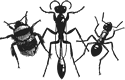


Myrmica schencki was added to the British list by Donisthorpe (1915) from Welsh specimens initially thought to be M. lobicornis. Workers and queens of both of these species have the antennal scape sharply angled at the base, with this bend bearing a broad upright flange. However, in M. schencki this flange is more strongly developed, with the width across the frontal lobes consequently smaller (e.g. Seifert 1998; Bolton 2005; Pontin 2005).
Most recently added content
Submitted by Anonymous on
,
Despite its generic name, this species is not classed as a wood ant.
Submitted by Anonymous on
,
This species was formerly recorded as Formica candida Smith, 1878 or Formica transkaucasica Nasonov, 1889. It is in a group of darker, more slender and agile species (the Serviformica) which includes the similar black species, F. fusca and F. lemani. Formica picea can be distinguished by its characteristic pilosity and shiny cuticle.
Submitted by Anonymous on
,
Lasius brunneus was first recorded in Britain by Donisthorpe in 1923 (Donisthorpe, 1927). It was not included as a British species in the first edition of Donisthorpe's British Ants (Donisthorpe 1915) and yet, within its current range, it is now locally common and easy to find. Workers of this species look superficially like the common black garden ant L. niger but can be distinguished by, their lighter brownish-red head and alitrunk contrasting with a dark gaster and an absence of standing hairs on the scapes.
Although found in other trees, occasionally in dead… Read more
Submitted by Anonymous on
,
Leptothorax acervorum was the only species remaining in Leptothorax after the other four British species were moved to Temnothorax (Bolton 2003) but the sibling species L. muscorum was found in the British Isles in 2026 L. acervorum are small myrmicine ants with distinct propodeal spines and three-segmented antennal clubs. L. acervorum are larger than the British Temnothorax species and can be distinguished by an 11-segmented antenna in the females (12 in males); the Temnothorax species have one extra funicular… Read more
Submitted by Anonymous on
,
Until recently the ant Temnothorax albipennis was known as Leptothorax albipennis (=tuberointerruptus) and had been misidentified as Temnothorax tuberum in Britain. It appears that all mainland records of Temnothorax tuberum refer to T. albipennis (Orledge, 1998). Workers of T. albipennis are smaller than those of Leptothorax acervorum, and generally distinguishable from workers of the three other British Temnothorax species, by their combination of darkened antennal clubs, straight and relatively short… Read more
Submitted by Anonymous on
,
This is one of twelve British ant species in the genus Myrmica. Individual workers of M. lobicornis tend to be more robust, rugose and darker reddish brown than other commonly encountered Myrmica; they can occasionally appear almost black although there is significant variation in colour. The available keys provide fairly clear characters for accurate determination of this species; the most pronounced feature is the conspicuous vertical flange at the bend of the antennal scape. Myrmica lobicornis is one of the least aggressive species of Myrmica… Read more
Submitted by admin on
,
To add family or subfamily texts to the taxon hierarchy, select Content management > Create content > Higher taxon from the admin menu at the top of the page. Set the page Title to the name of the taxon you are creating. In the Taxonomic hierarchy section, select the taxonomic levels down to and including the family or subfamily you are creating. Put the description you want to show in the Description box then save the page.
If you need to edit an existing description,… Read more