

Washing material caught in water or alcohol
Sam Droege demonstrates good practice in preparing specimens
Back to More Useful Resources
Sam Droege demonstrates good practice in preparing specimens
Back to More Useful Resources
2 videos by BWARS Corresponding member Sam Droege (US) demonstrating how to carry out efficient bowl trapping surveys
Terry Griswold's Pan trap monitoring protocols
Back to More Useful Resources
BWARS Corresponding member Sam Droege (US) demonstrating how best to use a handnet
Back to More Helpful Resources
Colletes hederae enjoyed another year of colonisation, consolidation and advance in 2011. The northerly limits of its range were extended northward on two fronts. The first crop of records occurred in the unseasonally hot weather at the end of September, when numerous records started coming in from a suite of sandy sites to the south of Oxford, with particularly large nesting aggregations noted from Dry Sandford Pit. We also received records from Cheltenham (Gloucestershire) which represents… Read more
Steady expansion and further consolidation would sum up the status of Colletes hederae after another good season for the bee.
There have been many records from areas colonised in prevous years, but 2010 has seen a considerable number of new records from inland sites in central Hampshire, new records from the Reading area of Berkshire and a significant number of observations from the southernmost parts of Surrey. What is clear now is that what were (a few years ago) distinct… Read more
2009 has been another excellent year both for Colletes hederae in UK and our monitoring effort. BWARS has gathered data from no less than 61 10x10km grid cells this year, of which no less than 33 represent entirely new locations. A glance at the map at the foot of this webpage will show that the most exciting areas for new sightings have been in west Kent, the north Kentish coast and south Essex (the first records from north of the Thames). I have also received a good number of records from… Read more
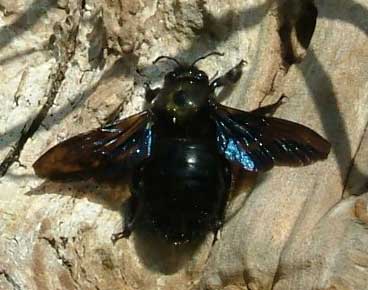
BWARS members Stuart Roberts and Lizzy Peat have followed up reported sightings of the large and impressive bee genus Xylocopa over-wintering in Shepshed, Leicestershire.
Following an internet forum report of Xylocopa-like bees over-wintering in a dead tree in a Shepshed garden, the householder concerned posted some photos of the bees, which confirmed there identity as Xylocopa species. Lizzy Peat… Read more
These details were submitted by member AM George 21 December 2008
Hibernating queen hornet Vespa crabro found beneath a rotting branch of cherry wood. Wood approximately 4 inches diameter, well rotted, with bark separating from heart wood. Wood flat on floor and well covered with moss. Found at base of south-facing slope within mixed/broad-leaved woodland.
Location: Bottom Wood, Radnage, Bucks.
OS grid reference: SU786957.
Rob Parker of the Suffolk Naturalists' Society sent me [Adrian Knowles] the following anecdote regarding an Osmia bicolor nest which he had previously observed being covered by pine needles as part of their "tent making" behaviour:
"I returned to the King's Forest on this morning's Dingy Skipper search, and found my O. bicolor nest had grown substantially since my last visit 11 days ago. We carefully lifted the pagoda of pine needles off, and found the snail shell had a large pine kernel over the top of it, so that it was quite… Read more